
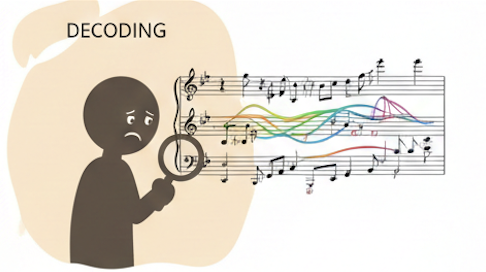
You decided to sit back down at the keys. You remembered the basics. You can still read the treble clef, and you might even remember that big “showpiece” you played for a recital when you were twelve.
But then you hit a wall.
You can “decode” the notes, but you can’t actually play them in real-time. You get stuck the moment the music gets “hard.” You realize you’ve forgotten the bass clef entirely, or you have no idea how to pick up where you left off if you miss a beat.
If this sounds like you, I have a secret: You aren’t bad at piano. You were just trained wrong.
The “Decoding” Trap
Most of us were taught to “read” music like we were looking at an museum plaque in a language we don’t speak. We can look at the text, look at a dictionary, and eventually figure out what the sign says. But we couldn’t ask for directions to the bathroom or order dinner in that language.
Traditional piano lessons often focus on “decoding”—looking at a symbol and finding a finger. But that isn’t fluency. Fluency is understanding the harmony, recognizing intervallic patterns, and feeling the rhythm in your body before you ever touch the keys.
Why You Feel “Stuck”
Returning pianists feel stuck because they never learned Functional Piano.
- They learned to memorize big pieces for competitions, but never learned to sight-read.
- They learned to play what was on the page, but never learned to harmonize a simple melody.
- They have no clue about the “grammar” of music (Harmony).
It’s like trying to recite a poem in a language you don’t understand. If you forget one word, the whole thing falls apart.
There is a Better Way
At ChordWise Piano, we do things differently. I don’t want you to just memorize; I want you to understand.
Imagine playing the piano the way you speak your native language—with total fluency, expression, and the ability to “pivot” if you make a mistake. That is what I call Piano Freedom.
Ready to stop decoding and start playing? Join our free community, Piano Freedom Beyond the Notes, and let’s fix your foundation together.