
Ever sat down at your piano, looked at the 88 black and white keys, and felt… stuck?
You’ve spent weeks, maybe months, mastering a specific classical piece. You’ve got the notes down. You’ve followed every crescendo and staccato mark to the letter. But the moment you finish that last note, the music stops. If someone asked you to “just play something,” would you freeze up?
Do you feel chained to sheet music?
You aren’t alone! So many adult learners feel like they are just “translating” ink on a page rather than actually making music. But here’s a secret: the most vibrant, soulful, and exciting music happens when you let go of the page.
Piano improvisation for adults doesn’t have to be a mystical gift reserved for jazz legends. It is a skill you can learn, and it starts with a few simple building blocks. Today, we are going to break those chains and show you how to master your very first solo using the power of chords.
Why Chords Are Your Best Friend
If you want to fly, you need a solid runway. In the world of music, that runway is made of chords.
When you learn piano chords for beginners, you aren’t just learning how to play three notes at once; you are learning the “skeleton” of every song ever written. Once you understand the skeleton, you can dress it up however you want!
Instead of worrying about every single individual note in a complex melody, improvisation allows you to lean on the harmony. By playing a simple, repetitive chord progression in your left hand, you create a safety net. This frees up your brain (and your right hand!) to explore, play, and create something brand new.
Step 1: The “Instant Professional” Chord Progression
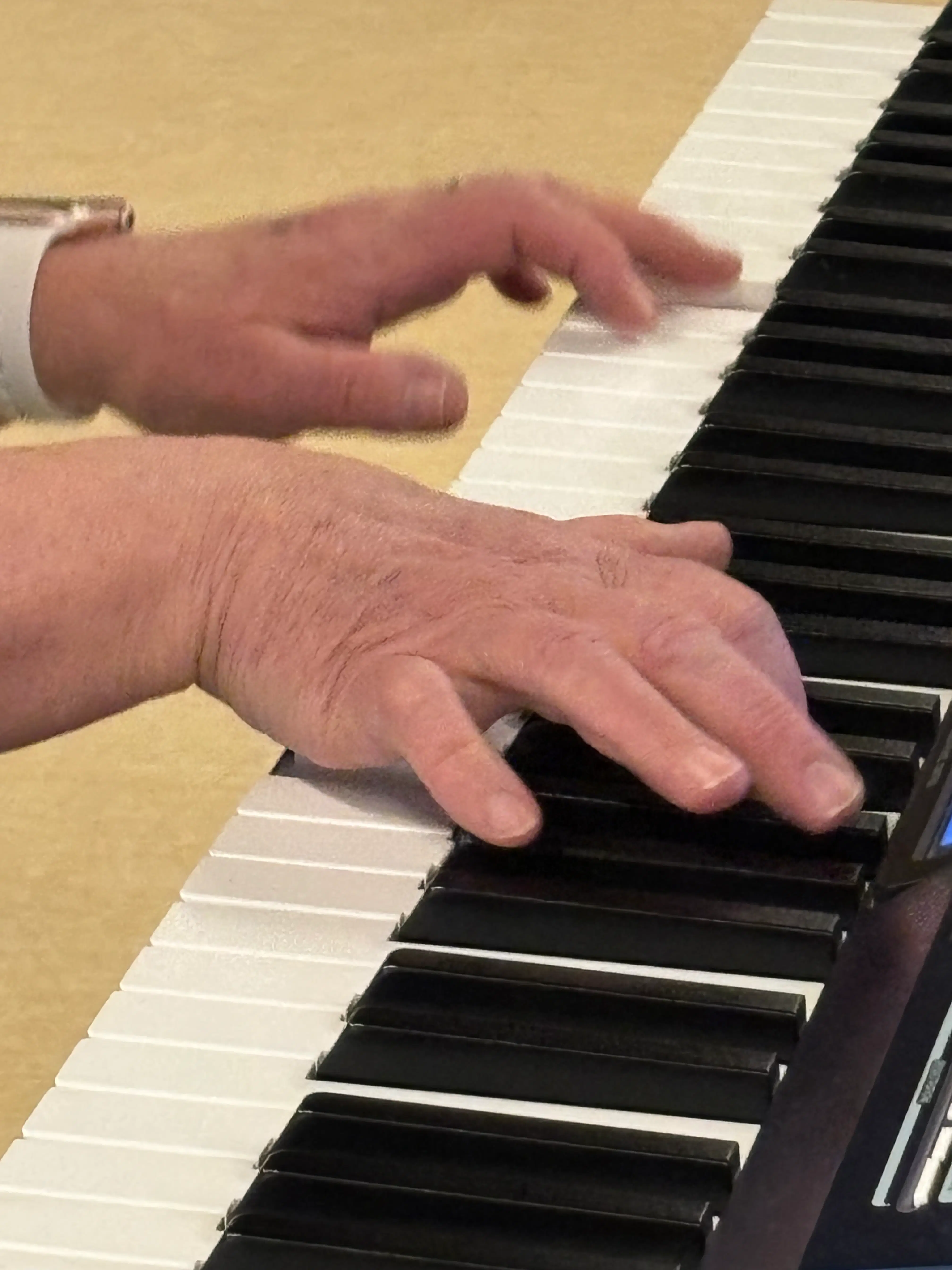
Let’s get your left hand moving. You don’t need anything fancy to sound sophisticated. We are going to use a progression that sounds hauntingly beautiful and works entirely on the white keys.
We call this a “6-5-4” progression in the key of C Major. Don’t let the numbers scare you! It just means we are playing:
- A minor (A – C – E)
- G major (G – B – D)
- F major (F – A – C)
Try playing these in your left hand. Just hold each one for four beats. Sounds nice, right? Now, if you want to sound like a pro instantly, try “spreading” the notes out. Instead of a block, play the bottom note, then the top note, then the middle note. This creates a shimmering, arpeggiated effect that provides a lush background for your solo.
For more tips on how to use these structures, check out our ChordWise Piano resources!
Step 2: The “Note Diet” (Less is More!)
Here is where most beginners trip up: they try to use every note on the piano at once. That’s like trying to learn a new language by reading the entire dictionary in one sitting. It’s overwhelming!
To master piano improvisation for adults, you need to put yourself on a “note diet.”
Start with just two notes in your right hand. Let’s pick C and E.
While your left hand plays those lovely chords we just talked about, your right hand is only allowed to play C and E.
- Play them short.
- Play them long.
- Play them together.
- Repeat a rhythm.
Is it simple? Yes. Does it sound musical? Absolutely! By restricting your choices, you take the guesswork away. You can’t play a “wrong” note because you’ve only given yourself “right” ones! Once you feel confident, add a third note, like D. Suddenly, you have a melody forming.

Step 3: Mastering the Rhythm
Improvisation is 50% notes and 50% rhythm. Even a single note can sound like a masterpiece if the rhythm is infectious.
When you are starting out, focus on 8th notes. These are your steady “walking” notes (1-and-2-and-3-and-4-and). Try to keep a consistent stream of 8th notes going over your chords. It builds a sense of momentum and “flow.”
Once you feel like you’ve got that down, sprinkle in some 16th notes. These are faster, punchy notes that add a spark of excitement. Think of them like the “spices” in a recipe: you don’t need a ton, but a little bit goes a long way in making your solo feel vibrant and professional.
The Secret Ingredient: Singing in Your Head
Do you want to know the “pro” trick that changes everything? Sing the melody in your head before your fingers touch the keys.
Music is a language. If you can hum a little tune, you can play it. Before you start your solo, try to “hear” a three-note melody in your mind. This connects your internal musical ear to your physical movements. It turns the piano into an extension of your voice.
This is the core of Piano by Ear, and it is the fastest way to stop “thinking” about theory and start “feeling” the music.

Overcoming the “Fear of the Wrong Note”
We’ve all been there. That moment of hesitation where you think, “What if I hit a note that sounds terrible?”
Here’s the truth: There are no wrong notes, only unexpected resolutions.
If you hit a note that sounds a bit “sour” or “crunchy,” don’t panic! Just move your finger one key to the left or right. Usually, you’ll land on a note that sounds perfectly resolved. In jazz, they say you’re only ever one half-step away from a great note.
Embrace the “crunch.” It adds character! Improvisation is about the journey, not perfection. It’s about the freedom to explore the keyboard without a map.
Your 10-Minute Daily Improvisation Routine
Ready to try it? Set a timer for 10 minutes and follow this simple path:
- Minute 1-2 (The Foundation): Play your left-hand chords (A minor, G major, F major). Get the rhythm steady.
- Minute 3-5 (The Note Diet): Use only the notes C, D, and E in your right hand. Experiment with different rhythms.
- Minute 6-8 (Expansion): Add G and A to your right-hand palette. Notice how the mood changes when you jump to a higher note!
- Minute 9-10 (The Jam): Forget the rules. Close your eyes, keep the left hand moving, and let your right hand dance. If you hit a “mistake,” repeat it three times: now it’s a “feature”!

Take Your Playing to the Next Level
Mastering your first solo is just the beginning. Imagine being able to sit down at a party, a wedding, or just in your own living room, and create a mystical, soulful atmosphere without needing a single piece of paper. That is the power of improvisation.
Learning to learn piano chords for beginners is the gateway to this freedom. It turns the piano from a daunting machine into a playground.
Are you ready to stop reading and start playing? Whether you are a total beginner or a returning student who is tired of the same old scales, I am here to help you find your unique musical voice.
Everything is spelled out for you in my ChordWise Piano method. We take the guesswork away and replace it with fun, creativity, and real results.
Click here to explore our lessons and start your journey toward musical freedom today!
You have a song inside you: let’s find the chords to set it free! Happy playing! 🎹✨