
![[HERO] Why Reading Piano Music is Harder Than You Think (And How to Fix It)](https://cdn.marblism.com/mLcFp1BIsMf.webp)
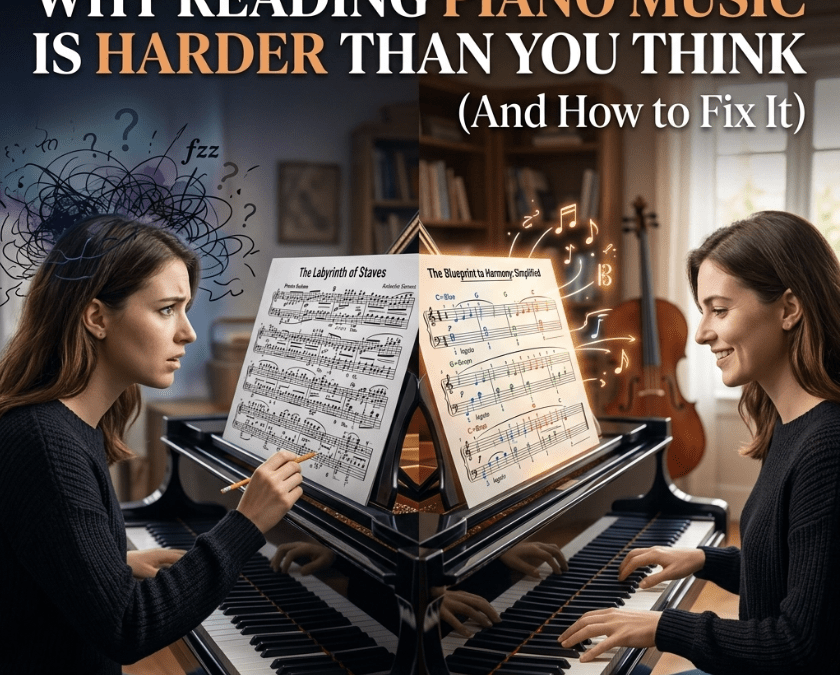
If you’ve ever sat down at a piano, stared at a tangled mess of black dots on a page, and felt like you were trying to solve a Rubik’s cube while riding a unicycle… welcome to the club. You aren’t “bad at music.” You aren’t “uncoordinated.” You are simply wrestling with one of the most cognitively demanding tasks the human brain can attempt.
I meet people all the time, adult learners, mostly, who tell me they’ve played for 10 or 15 years, yet they still feel like they’re “reading” music one painful note at a time. They feel like they’re stuck in a “red ocean” of rigid perfectionism, drowning in the frustration of never feeling truly literate.
Today, I want to pull back the curtain on why piano literacy is so uniquely difficult and show you the “Blue Ocean” of creative confidence. We’re going to stop deciphering code and start speaking the language.
The Cognitive Overload: Why Your Brain is Screaming
Let’s be honest: the piano is a bit of a bully. If you play the violin or the flute, you generally have one line of music to read and one clef to master. Your brain focuses on a single melodic stream.
But the piano? The piano demands you read the Grand Staff. That means your brain is processing:
- The Treble Clef (Right hand)
- The Bass Clef (Left hand)
- Ten Fingers moving independently
- Rhythm (The “when” of the notes)
- Dynamics and Articulation (The “how” of the notes)
It is a massive amount of data to process in real-time. In a lot of ways, piano reading is like decoding a spreadsheet while moving ten fingers. You’re scanning vertical stacks, horizontal patterns, timing grids, hand coordination, and expressive details all at once. That’s a huge ask for any brain.
When you’re reading note-by-note, you’re basically asking your brain to spell out every single letter in a 500-page novel while trying to maintain a conversation. It’s exhausting! No wonder so many people quit or stay stuck at the beginner-intermediate plateau for a decade.
Literacy vs. Fluency: Are You Just “Deciphering Code”?
Most traditional piano methods teach music reading as a form of deciphering code. You see a dot on the second line of the staff, you think “Every Good Boy Does Fine,” you identify it as a G, and then you find the G on the keys.
That isn’t reading; that’s translation.
True fluency happens when you stop seeing “dots” and start seeing patterns. Think about how you’re reading this blog post right now. You aren’t looking at the “b,” then the “l,” then the “o,” then the “g.” You see the word “blog” as a single unit. You might even see the phrase “blog post” as a single unit.
And if reading still feels painfully slow, there are usually a few very fixable reasons why.
4 Common Reasons Piano Reading Feels So Hard
- You’re relying on muscle memory more than reading.
Maybe you learned pieces by repetition, finger choreography, or listening first. That can absolutely get a song under your hands, but it does not always build fluent reading. Then when you open new music, it feels like starting from scratch every time. - You haven’t been taught to recognize patterns fast enough.
If every interval, chord, and scale fragment looks like separate dots, your brain gets overloaded. Strong readers don’t process every note individually. They see shapes, gestures, and harmonic chunks. - You haven’t had enough truly easy reading material.
This one is huge. So many adults practice music that is just a little too hard for real fluency. If the level is always stretching you, your reading never gets enough repetition to become automatic. Easy reading is not “babyish.” It is training. - Rhythm is the bottleneck.
Sometimes the notes are not the real issue. The rhythm is. If the timing is shaky, the whole reading process jams up. You pause, second-guess, stop the flow, and suddenly the page feels ten times harder than it actually is.
My philosophy is simple: Structure unlocks freedom. When you understand the architecture of a piece of music, the individual notes stop being scary. They start being logical.
The “Internal Map”: Why Chords are the Secret Sauce
This is where the ChordWise Piano Method comes in. Instead of starting with “isolated dots,” we start with the “internal map”, the chords.
Think of a piece of music as a house. If you only look at the individual bricks (the notes), you have no idea what the building looks like. But if you look at the blue-prints (the chords), you suddenly understand where the kitchen is, where the stairs go, and why the walls are where they are.
When you see a C-Major chord on a page, you shouldn’t see three separate notes (C, E, and G). You should see one single “chunk” of information.

“But Jenny, Will Lead Sheets Ruin My Ability to Read ‘Real’ Music?”
I hear this concern a lot from adult students who are worried that learning lead sheets or “playing by ear” is a form of cheating. They worry they’ll become “lazy” readers.
Actually, the opposite is true, as long as there’s balance.
Lead sheets and chord-based playing can reduce cognitive load in a really healthy way. Instead of forcing your brain to decode every single note, they help you organize the music around its harmonic structure. That gives you fewer things to process at once, which means more brain space for rhythm, flow, listening, and confidence.
This is what I think of as harmonic literacy.
When you understand chords and lead sheets, you start looking at a traditional score with the eyes of a composer-minded player. Instead of seeing a terrifying flurry of 16th notes in a Mozart sonata, you see “Oh, that’s just a C-Major scale fragment over a G7 chord.”
That shift matters. A lot. Because now you are not just reacting to ink on a page. You are understanding what the music is made of.
And no, that does not harm reading. It strengthens reading by giving the notes context. You start recognizing:
- chord shapes
- accompaniment patterns
- scale fragments
- cadences
- likely finger pathways
Suddenly, the “real” music becomes ten times easier to read because you’ve already mapped out the territory. You aren’t wandering in the woods anymore; you’re following a paved path. My background in orchestras and bluegrass jams taught me this firsthand. In an orchestra, you see the massive complexity of the score; in a bluegrass jam, you learn the raw power of the I, IV, and V chords. When you combine those two worlds, you get a superpower.
The key is balance. If you only ever read dense notation, you may stay trapped in decoding mode. If you only ever use chord symbols and never touch written music, you may miss some reading development. But when you combine both? You build a fuller, freer musicianship. You become someone who can read, understand, improvise, and adapt. In other words, a composer-minded player.
Moving from the “Red Ocean” to the “Blue Ocean”
In the business world, a “Red Ocean” is a crowded, bloody space where everyone is fighting over the same tiny prizes. In piano learning, the Red Ocean is the world of rigid perfection. It’s the world where you’re terrified of a wrong note, where you feel “chained” to the sheet music, and where you feel like a failure if you can’t sight-read a Chopin Etude perfectly on the first try.
I want to take you to the Blue Ocean.
The Blue Ocean is the space of creative confidence. It’s where you have the freedom to improvise, the skills to lead a sing-along, and the structural understanding to learn new pieces in half the time. It’s about the joy of the music, not the fear of the page.
If you’ve struggled for years, it’s not because you aren’t “musical enough.” It’s because the method you were using was making you do all the hard work without giving you the map!
How We Bridge the Gap
In my studio and through the video library, we focus on making the complex feel simple. We use:
- Visual Patterns: Learning to recognize shapes on the staff rather than just letter names.
- Harmonic Awareness: Identifying the “home base” chords so you always know where your hands should be.
- Rhythmic Skeletons: Stripping away the “fancy stuff” to find the heartbeat of the song first.
Whether you are a total beginner or someone returning to the piano after a long hiatus, my goal is to give you that “Aha!” moment where the music finally makes sense.

You Can Do This (Really!)
Learning to read piano music doesn’t have to be a lifelong struggle. By shifting your focus from “deciphering” to “understanding,” you can unlock a level of freedom you never thought possible.
Imagine sitting down at a piano and feeling excited to see a new piece of music because you know you have the tools to break it down. Imagine the “soulful” feeling of playing a song for friends without having to glue your eyes to every single ink mark on the page. That’s the “vibrant” musical life that’s waiting for you.
If you’re ready to stop the struggle and start the music, I’d love to help you on your journey. Check out our student resources or take a look at my testimonials to see how other adult learners have found their “Blue Ocean” of confidence.
Everything is spelled out. The guesswork is gone. Let’s get playing!

Ready to dive in?
Visit jennybpeters.com to find the books, videos, and lessons that will turn your piano frustration into piano passion. You’ve got this!